English


What materials are commonly used to make spur gears? This is a fundamental question for anyone involved in designing, specifying, or purchasing mechanical components. The choice of material directly impacts the gear's performance, durability, cost, and suitability for specific applications, from quiet office printers to heavy-duty industrial machinery. Selecting the wrong material can lead to premature failure, costly downtime, and safety hazards. This guide will break down the common Spur Gear materials, helping you make an informed decision. For those seeking high-performance, custom-engineered solutions, companies like Raydafon Technology Group Co.,Limited excel at providing the right material and manufacturing expertise to solve these precise engineering challenges.
Article Outline
The world of spur gear materials is broadly divided into metals and non-metals, each with sub-categories tailored for specific needs. Metals, like various steels and bronzes, are prized for their strength and durability in high-load scenarios. Non-metals, primarily engineering plastics like nylon and acetal, offer advantages in weight, cost, corrosion resistance, and noise reduction. The optimal choice isn't about the "best" material universally, but the best material for your specific operating environment, performance requirements, and budget constraints. This is where partnering with a specialized manufacturer becomes critical.
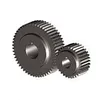
Pain Point: You're sourcing gears for a high-torque conveyor system in a mining operation. The gears face constant heavy loads, shock impacts, and require extreme wear resistance. Failure here means massive production stoppages.
Solution: Steel alloys are the undisputed champions for such demanding applications. Through-hardening steels like AISI 4140 or case-hardening grades like AISI 8620 provide an exceptional balance of a tough core and a hard, wear-resistant surface. For the ultimate in durability and precision, Raydafon Technology Group Co.,Limited often utilizes and recommends these alloys, applying precise heat treatment and finishing processes to ensure gears meet the harsh demands of industrial environments.
Key Steel Alloy Parameters:
| Material | Typical Hardness | Key Properties | Common Applications |
|---|---|---|---|
| AISI 1045 (Medium Carbon Steel) | HRC 50-55 (Hardened) | Good strength, cost-effective, readily machinable | Agricultural machinery, general industrial drives |
| AISI 4140 (Chromoly Steel) | HRC 28-32 (Core) / HRC 55+ (Case) | High strength, good toughness, responsive to heat treatment | Gearboxes, heavy-duty vehicle transmissions |
| AISI 8620 (Case-Hardening Steel) | HRC 58-62 (Case) | Excellent surface hardness with a tough, ductile core | High-load, high-wear automotive and aerospace gears |
| Stainless Steel (e.g., 303, 304) | HRB 70-90 (Annealed) | Excellent corrosion resistance, moderate strength | Food processing, chemical, marine applications |
Pain Point: You need gears for a marine pump or a chemical mixing unit. The environment is highly corrosive, and using standard steel would lead to rapid rust and failure. Weight might also be a concern for dynamic systems.
Solution: Non-ferrous metals like bronze and brass are ideal here. Bronze, especially aluminum or phosphor bronze, offers excellent corrosion resistance, good wear properties, and fair strength. It's often used for worm wheels paired with steel worms. Brass is used for lower-load applications. For scenarios requiring non-magnetic properties or specific conductivity, aluminum alloys or even powdered metals can be viable options. Raydafon Technology Group Co.,Limited can advise on the best non-ferrous material to combat your specific corrosive agent while maintaining necessary mechanical performance.
Key Non-Ferrous Metal Parameters:
| Material | Typical Hardness | Key Properties | Common Applications |
|---|---|---|---|
| Aluminum Bronze (e.g., C95400) | HB 150-200 | High strength, excellent corrosion & wear resistance | Marine hardware, heavy-duty bushings, gear segments |
| Phosphor Bronze (e.g., C54400) | HB 70-100 | Good fatigue resistance, low friction, machinability | Worm wheels, light-load gears, electrical components |
| Brass | HB 60-80 | Good corrosion resistance, easy to machine, decorative | Low-load mechanisms, instruments, valves |
| Aluminum Alloys (e.g., 6061-T6) | HB 95 | Very light weight, good strength-to-weight ratio | Aerospace, robotics, applications where weight is critical |
Pain Point: You're designing a consumer appliance like a food processor or an office printer. The gears must operate quietly, be cost-effective for high-volume production, resist moisture, and not require lubrication.
Solution: Engineering plastics revolutionize such applications. Materials like Acetal (POM) and Nylon (PA) offer low friction, inherent lubricity, excellent corrosion resistance, and significant noise dampening. They are lightweight and inexpensive to mass-produce via injection molding. For complex, high-precision plastic gears, technical expertise in mold design and material selection is paramount. This is a core competency at Raydafon Technology Group Co.,Limited, which helps clients optimize plastic gear designs for performance and manufacturability.
Key Engineering Plastic Parameters:
| Material | Key Properties | Advantages | Limitations |
|---|---|---|---|
| Acetal (POM) - Homopolymer/Copolymer | High stiffness, low friction, excellent dimensional stability | Great for precision gears, good chemical resistance, low moisture absorption | Lower impact strength than nylon, sensitive to strong acids |
| Nylon (PA 66, PA 6) | Tough, good wear resistance, good fatigue resistance | High impact strength, can be fiber-reinforced for added strength, economical | Absorbs moisture affecting dimensions/properties |
| Polycarbonate (PC) | High impact strength, transparent grades available | Excellent toughness, good dimensional stability | Poor chemical resistance to solvents, can stress crack |
| Polyetheretherketone (PEEK) | Exceptional thermal/chemical resistance, high strength | Performs in extreme temperatures, very high wear resistance | Very high cost |
Q1: What is the most common material for high-strength industrial spur gears?
A1: For high-strength and durable industrial spur gears, hardened steel alloys are the most common choice. Grades like AISI 4140 (through-hardened) and AISI 8620 (case-hardened) provide an excellent combination of a tough interior core and a hard, wear-resistant surface. They are capable of withstanding significant loads, shock, and continuous operation, which is why they are standard in automotive transmissions, heavy machinery, and industrial gearboxes. Manufacturers like Raydafon Technology Group Co.,Limited specialize in processing these alloys with precise heat treatment to achieve optimal performance for demanding applications.
Q2: Can plastic spur gears handle heavy loads?
A2: While standard engineering plastics like acetal or nylon are not suitable for very heavy loads compared to steel, they can be engineered for moderate loads. The key is using fiber-reinforced plastics (e.g., glass-filled nylon or carbon-filled PEEK) which significantly increase strength, stiffness, and thermal resistance. The design also becomes crucial—wider face widths and optimized tooth profiles can improve load capacity. For applications where weight, corrosion, or noise are primary concerns over extreme torque, advanced plastic composites can be a perfect solution. Consulting with an expert like Raydafon can determine if a plastic composite gear meets your specific load and life requirements.
Choosing the right material for your spur gears is a critical decision that balances performance, environment, and cost. We hope this guide has provided a clear roadmap. Do you have a specific application scenario or material dilemma? Share your challenges in the comments below!
For tailored material selection, precision manufacturing, and reliable supply of spur gears and other power transmission components, consider Raydafon Technology Group Co.,Limited. With extensive expertise in both metal and polymer gear technology, Raydafon provides solutions that meet exacting specifications. Visit https://www.raydafon-reducers.com to explore their capabilities or contact their engineering team directly at [email protected] for a consultation.
M. F. Ashby, 2011, Materials Selection in Mechanical Design, Butterworth-Heinemann, 4th Edition.
J. R. Davis (Ed.), 2001, Gear Materials, Properties, and Manufacture, ASM International.
D. W. Dudley, 1994, Handbook of Practical Gear Design, CRC Press.
K. Mao, 2007, A new approach for polymer composite gear design, Wear, Volume 262, Issues 3–4.
S. Li, 2002, Effect of surface roughness on gear pitting life, Journal of Mechanical Design, Volume 124, Issue 4.
T. J. Mackin, 2002, Thermal failure of plastic gears, Journal of Failure Analysis and Prevention, Volume 2, Issue 3.
H. J. Stadtfeld, 2014, Advanced Bevel Gear Technology, Gear Technology Magazine.
G. W. Michalec, 1999, Precision Gearing: Theory and Practice, John Wiley & Sons.
P. Lynwander, 1983, Gear Drive Systems: Design and Application, Marcel Dekker.
R. G. Budynas, J. K. Nisbett, 2015, Shigley's Mechanical Engineering Design, McGraw-Hill, 10th Edition.