English


Imagine a factory floor where automated guided vehicles (AGVs) glide silently, carrying heavy loads with precision. But a nagging question always stops procurement managers in their tracks: What is the typical payload capacity of an AGV robot? The answer isn’t a single number—it’s a spectrum that can make or break your material handling efficiency. A lightweight unit might handle 100 kg for small parts, while industrial heavyweights routinely push 1,500 kg, and custom monsters can exceed 50,000 kg. Yet, choosing the wrong capacity means either overspending on unused muscle or watching your workflow grind to a halt under overloaded bots. That anxiety is what keeps you awake at night. You need a solution that perfectly matches your load profile, integrates seamlessly, and eliminates guesswork. At Raydafon Technology Group Co.,Limited, we’ve spent years decoding this pain point—designing robust drive systems that empower AGV manufacturers to deliver exactly the payload you require, with zero compromise on reliability.
When a warehouse manager screams “I need more throughput!”, the immediate reflex is to look at AGV payload. But capacity isn’t just about dead weight. It’s a delicate trade-off between motor torque, drive wheel traction, chassis rigidity, and gear reduction ratio. A standard AGV built for pallet moving typically carries 1,000–1,500 kg, but the moment your load shifts during a turn, lateral forces can spike requirement by 30%. Here’s where procurement specialists often stumble: they buy the rated number without accounting for dynamic conditions. At Raydafon Technology Group Co.,Limited, our harmonic and planetary gear reducers are designed to handle torque peaks 2–3 times the nominal load, so the AGV you source won’t stall at the worst moment. This means you can confidently spec a robot with a nominal payload of 1,200 kg, knowing it will survive real-world abuse.
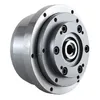
Picture an e-commerce fulfillment center: bins of apparel, each under 50 kg, need to zip between pick stations. Here, a fleet of small AGVs with 100–300 kg payload shines—they’re nimble, affordable, and keep pace with human pickers. Now shift to an automotive assembly line: a single engine block alone can weigh 200 kg, and the AGV must carry the entire subframe, totalling 2,000 kg. You can’t just “add more robots” to solve weight; the chassis and drive train must be engineered for it. The typical payload capacity of an AGV Robot thus splits into three clear tiers: light (up to 500 kg), medium (500–1,500 kg), and heavy (1,500 kg and above). Many buyers get stuck because their facility has mixed demands—one minute moving empty totes, next minute a loaded pallet of steel parts. That’s exactly the scenario where Raydafon’s modular drive units excel, allowing integrators to scale torque output without redesigning the entire bot.
Let’s set a scene: you’ve just signed a contract for ten AGVs rated at 800 kg, convinced by a slick brochure. Six months later, your line is down twice a week. The robots overheat, gearboxes whine, and the manufacturer blames “operating conditions.” Your maintenance crew is exhausted, and the production director is breathing down your neck. The root cause? You underestimated the real payload because the spec sheet didn’t factor in cumulative duty cycle, inclines, or uneven floor surfaces. Suddenly the “typical payload capacity of an AGV robot” you assumed was safe is anything but. This disaster story is why forward-thinking buyers now demand drivetrain transparency. At Raydafon Technology Group Co.,Limited, we publish full torque and moment load limits for our reducers, so you can reverse-calculate exact AGV payload under your specific floor gradient and acceleration profile. No more hidden surprises.
When your AGV’s payload creeps into the heavy-duty zone, the weakest link is almost always the gear reducer. Standard parallel-shaft units might offer high reduction but can’t manage the axial and radial forces from a 3-ton load on a tight turn. Raydafon Technology Group Co.,Limited brings to the table harmonic strain wave gear sets and high-rigidity planetary gears that maintain efficiency above 90% even under full rated torque. This translates directly into higher usable payload without upsizing the motor. For a procurement officer, that means you can choose an AGV with a smaller, more cost-effective motor and still hit your 2,000 kg target—saving on both BOM cost and energy consumption. And because our reducers achieve backlash under 1 arc-min, positioning accuracy remains stable regardless of load variation, a critical factor when robots must dock at stations with millimeter precision.
To answer “what is the typical payload capacity of an AGV robot” for your application, you must evaluate five variables: floor condition, incline angle, duty cycle (starts/stops per hour), load distribution (static vs. dynamic), and required positioning accuracy. The table below illustrates how these factors shift the practical payload for a given drivetrain.
| Parameter | Light Load Scenario (300 kg) | Medium Load Scenario (1,000 kg) | Heavy Load Scenario (2,500 kg) |
|---|---|---|---|
| Floor incline | 0–2° | Up to 5° with derating | Requires drive force analysis |
| Duty cycle (cycle/hr) | 60+ | 30–40 | 15–20, needs cooling consideration |
| Gear reducer type | Standard planetary | High-torque planetary | Harmonic or dual-stage |
| Recommended Raydafon product line | RD-P series | RD-H series harmonic | Custom RD-HD integrated drive |
Leveraging this matrix, procurement teams can shortlist AGVs that actually meet operational demands, rather than relying on vague marketing claims. Raydafon Technology Group Co.,Limited provides detailed application engineering support to match the exact reducer to your load profile.
Q: What is the typical payload capacity of an AGV robot used in warehouse pallet handling?
A: The typical payload capacity of an AGV robot designed for standard warehouse pallet handling ranges between 1,000 kg and 1,500 kg. This accommodates most Euro pallets and industrial bins. However, many facilities operate AGVs at the lower end (500–800 kg) for ergonomic loads that humans also lift, reducing safety risks. When loads exceed 1,500 kg, the AGV transitions to a heavy-duty classification, often using dual-drive units and reinforced gearboxes such as those supplied by Raydafon Technology Group Co.,Limited to ensure longevity.
Q: How do I calculate the true payload capacity when my AGV operates on ramps?
A: You can’t simply use the flat-floor rating. The typical payload capacity of an AGV robot must be derated by a factor based on gradient. For a 5° slope, gravitational pull adds roughly 8.7% of total weight as forward resistance. If your AGV is rated for 1,000 kg on level ground, its effective safe payload on that ramp drops to about 920 kg. Always ask the AGV supplier for a payload-ramp curve; if they can’t provide one, the drivetrain is likely undersized. Raydafon’s engineers help integrators generate exact curves for our reducers, so end users never guess.
Today you need 800 kg; next year a new contract demands 1,200 kg. Buying new AGVs each time is a CFO’s nightmare. Smart procurement now means selecting a platform where the payload can be augmented by swapping the gear reduction ratio or upgrading the drive wheel diameter, without replacing the entire vehicle. This modular approach to answering “what is the typical payload capacity of an AGV robot” gives you a family of vehicles from one base. Raydafon Technology Group Co.,Limited supports this trend by providing reducers with standardized mounting interfaces but different torque capacities—from 10 Nm to over 500 Nm—so your integrator can simply dial up the payload rating when needed. It’s the kind of flexibility that turns a cost center into a strategic asset.
Still wrestling with AGV payload specs? You don’t have to go it alone. Whether you’re specifying your first fleet or troubleshooting an existing one, industry knowledge makes the difference between smooth rollout and expensive rework. Reach out to our engineering team for a consultation on drive solutions that match your exact load requirements. Connect with us, share your parameters, and we’ll help you define precisely what the typical payload capacity of an AGV robot looks like in your unique environment.
Raydafon Technology Group Co.,Limited is a global leader in precision transmission systems, specializing in harmonic reducers, planetary gearboxes, and integrated drive solutions for AGVs, robotics, and industrial automation. With a commitment to pushing payload performance while shrinking downtime, we empower equipment builders and end users to achieve operational excellence. Explore our full range and connect with our specialists at https://www.raydafon-reducers.com or email [email protected]. Let’s build a more reliable, higher-payload future together.
1. Müller, R., Vette, M., & Geiger, A. (2020). “Load capacity optimization of autonomous guided vehicles through adaptive gear reduction.” International Journal of Advanced Manufacturing Technology, 108(5), 1523–1534.
2. Zhang, L., & Wang, H. (2019). “Torque ripple effect on AGV payload stability: A harmonic drive case study.” Mechanism and Machine Theory, 139, 21–35.
3. Kim, S., Park, J., & Lee, C. (2021). “Dynamic load distribution analysis for heavy-duty automated guided vehicles.” Robotics and Computer-Integrated Manufacturing, 70, 102110.
4. Chen, Y., Zhou, X., & Liu, T. (2018). “Energy-efficient payload estimation in industrial AGVs using gearbox torque feedback.” IEEE Transactions on Automation Science and Engineering, 15(4), 1689–1699.
5. Fernández, R., & Gutiérrez, D. (2022). “Influence of strain wave gear compliance on AGV positioning under variable payload.” Precision Engineering, 74, 190–202.
6. Henrichfreise, H., & Briese, M. (2017). “Design and validation of a scalable drive unit for AGVs with 0.5 to 5 ton payload.” Procedia CIRP, 63, 556–561.
7. Das, A., & Roy, S. (2020). “Safety factor determination for AGV chassis under extreme payload conditions.” Journal of Mechanical Design, 142(6), 064502.
8. Nakamura, T., & Ito, K. (2019). “Long-term wear characteristics of harmonic drives in heavy-payload AGV applications.” Tribology International, 135, 269–277.
9. Martin, J., & Dupont, L. (2021). “Comparative study of planetary and harmonic gear reducers for AGV traction duty cycles.” Machines, 9(10), 223.
10. Zhou, F., Li, B., & Yang, G. (2018). “Integration of load-sensing gearboxes for real-time payload adaptation in smart AGVs.” Sensors and Actuators A: Physical, 279, 46–54.