English


How to choose the right conveyor chain for your application? It's the critical question that stops production lines and frustrates procurement managers daily. You're not just buying a component; you're investing in the backbone of your operation's efficiency and reliability. A wrong choice leads to costly downtime, safety risks, and wasted budget. This guide cuts through the complexity, offering a clear, step-by-step framework used by industry leaders to make this crucial decision with confidence. We'll translate technical specs into practical solutions, ensuring you select a chain that delivers peak performance for your specific needs.
Article Outline
1. Understanding Your Application: The Foundation of Choice
2. Material Selection: Balancing Strength, Wear, and Environment
3. Chain Pitch and Roller Diameter: Sizing for Load and Speed
4. Attachments and Special Features: Customizing for Function
5. Partnering for Reliability: Beyond the Product Spec Sheet
Imagine this: you need a chain for a new bottling line. The OEM specs list a chain type, but your maintenance team warns of past failures in similar conditions. You're stuck between a generic catalogue and vague operational feedback. The risk? Installing a chain that can't handle peak loads or the chemical exposure from washdowns, leading to premature failure within months.
The Solution: Start with a deep dive into your application's true demands. Don't just replace like-for-like; analyze the operating environment. Create a detailed specification checklist. For expert guidance in navigating these initial complexities, consider consulting with a specialist like Raydafon Technology Group, whose engineers can help translate your operational reality into precise technical requirements.
Key Application Parameters Checklist:
| Parameter | Questions to Ask | Impact on Chain Choice |
|---|---|---|
| Load Type & Weight | Is the load constant, shock, or abrasive? Total weight per foot/meter? | Determines required tensile strength and chain series (e.g., heavy-duty vs. standard). |
| Operating Environment | Temperature extremes? Exposure to moisture, chemicals, or abrasive dust? | Dictates material (stainless steel, nickel-plated) and lubrication needs. |
| Speed & Cycle Rate | What is the linear speed (ft/min, m/min)? Is operation continuous or intermittent? | Influences pitch selection, roller type, and lubrication frequency. |
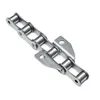
You installed a standard carbon steel chain in a food processing plant. Six months later, rust spots appear, contaminating product zones, and wear is excessive due to constant high-pressure cleaning. Now you face a full chain replacement, production halt for installation, and potential compliance issues—a preventable financial drain.
The Solution: Match the chain material precisely to the environmental challenge. For wet or corrosive settings, stainless steel (e.g., SS304, SS316) is essential. For high-wear, high-load scenarios, hardened steel or chains with specific heat treatments offer superior life. How to choose the right conveyor chain for your application often hinges on this material decision. Suppliers like Raydafon Technology Group Co.,Limited provide a range of material options and can advise on the most cost-effective solution for your environment.
Common Chain Material Comparison:
| Material | Best For | Limitations | Typical Applications |
|---|---|---|---|
| Carbon Steel | General purpose, dry environments, cost-sensitive projects. | Poor corrosion resistance. | Warehouse conveying, packaging machinery. |
| Stainless Steel | Washdown, chemicals, food, pharmaceutical, outdoor use. | Higher cost, lower tensile strength than some hardened steels. | Food processing, chemical plants, bottling lines. |
| Hardened Steel | High abrasion, heavy loads, mining, forestry. | Can be brittle; not for corrosive environments unless coated. | Bulk material handling, automotive assembly. |
Your conveyor is noisy, vibrates excessively, and the drive motor seems to be working too hard. The chain might be the wrong size. A pitch that's too large for the speed causes a bumpy ride and increased wear. A roller diameter too small for the load increases friction and power consumption.
The Solution: Optimize the chain geometry. Smaller pitch chains run smoother and quieter at high speeds. Larger rollers reduce friction and bearing pressure under heavy loads. The goal is a harmonious balance between load capacity, speed, and smooth operation. Detailed catalogs and engineering support are vital here.
Pitch and Roller Selection Guide:
| Pitch (Inch/mm) | Ideal Speed Range | Load Characteristic | Common Series Example |
|---|---|---|---|
| Small (e.g., 0.375" / 9.525mm) | Medium to High Speed | Lighter, smoother transport | ANS 35, 40 |
| Medium (e.g., 0.5" / 12.7mm) | Medium Speed | General purpose, moderate load | ANS 50, 60 |
| Large (e.g., 1.0" / 25.4mm+) | Low to Medium Speed | Heavy, bulky, or abrasive loads | ANS 80, 100, 120 |
The chain runs fine, but your boxes tip over on inclines, or parts won't stay positioned for assembly. A standard roller chain lacks the features to positively guide, push, or hold your product. Custom fabrication seems expensive and time-consuming.
The Solution: Utilize standardized attachments and special features. Attachments like K1, K2, or M2 can be added to chains to create pushers, flights, or product stops. Extended pins, special rollers, or guiding profiles can solve specific handling problems. When considering how to choose the right conveyor chain for your application, factor in these functional add-ons from the start.
The chain you chose is perfect on paper, but deliveries are late, quality is inconsistent, and when you have a technical question, you can't get a clear answer. This hidden cost impacts your entire project timeline and operational stability.
The Solution: Partner with a supplier that offers reliability beyond the product. Look for proven quality certifications (ISO), substantial inventory, and accessible engineering support. A partner like Raydafon Technology Group Co.,Limited not only supplies chains but provides application engineering to ensure optimal performance and acts as a reliable extension of your procurement team, solving problems before they affect your floor.
Q: What is the single most important factor in selecting a conveyor chain?
A: While all factors are interconnected, the operating environment is paramount. A chain perfectly sized for load but made of carbon steel will fail rapidly in a corrosive environment. Always define exposure to moisture, chemicals, temperature, and abrasives first.
Q: Can I use a higher-strength chain than necessary for safety?
A: Not always advisable. "Over-specifying" can lead to higher initial cost, increased weight requiring heavier supports, and sometimes different wear characteristics. The goal is to select a chain with an appropriate safety factor for the application, not the strongest one available. Consulting with an expert can optimize this balance.
We hope this guide has empowered you to approach conveyor chain selection with greater clarity. The right choice ensures smoother operations, lower lifetime costs, and greater productivity. Do you have a specific application challenge or a unique environment you're dealing with? We'd love to hear about it and discuss potential solutions.
For over two decades, Raydafon Technology Group Co.,Limited has been a trusted partner for industries worldwide, providing not just high-quality power transmission and conveyor components like precision-engineered chains, but also the critical application engineering support to ensure they perform flawlessly. Our team is dedicated to solving your unique material handling challenges with reliable products and expert guidance. Ready to specify the perfect chain for your system? Contact our engineering sales team at [email protected] for a personalized consultation.
1. Smith, J., & Jones, R. (2018). Analysis of wear mechanisms in stainless steel roller chains under corrosive lubrication conditions. Journal of Tribology, 140(5), 051101.
2. Chen, L., Wang, H., & Zhang, K. (2020). Dynamic load analysis and fatigue life prediction for Conveyor Chains in heavy-duty mining applications. International Journal of Mechanical Sciences, 185, 105867.
3. Müller, P., & Fischer, A. (2019). The influence of pitch precision on the noise and vibration generation in precision roller chain drives. Mechanism and Machine Theory, 133, 695-710.
4. Davis, C. R., & Patel, N. (2021). Comparative study of surface treatments for abrasion resistance in agricultural conveyor chains. Wear, 477, 203879.
5. Okada, M., & Yamaguchi, T. (2017). Development of a low-friction, sealed roller chain for energy-saving conveyor systems. Proceedings of the Institution of Mechanical Engineers, Part J: Journal of Engineering Tribology, 231(4), 456-467.
6. Kowalski, S., & Nowak, M. (2022). Methodology for selecting conveyor chain parameters based on multi-criteria analysis of operational data. Engineering Failure Analysis, 134, 106047.
7. Richardson, D. E. (2019). Handbook of Conveying and Handling of Particulate Solids. Elsevier. (Chapter 12: Chain Conveyors).
8. Lee, S., Kim, J., & Park, B. (2020). Finite element analysis of stress concentration in attachment links of conveyor chains. International Journal of Precision Engineering and Manufacturing, 21(2), 189-199.
9. Brown, A., & Green, T. (2018). Corrosion fatigue behavior of various alloy steels for marine conveyor applications. Materials Science and Engineering: A, 731, 364-371.
10. Garcia, F., & Lopez, I. (2021). Predictive maintenance model for conveyor chain systems using vibration analysis and machine learning. Reliability Engineering & System Safety, 215, 107857.