English


“How do I choose the right size shaft collar?” This question haunts every engineer and procurement specialist facing a project where precision, safety, and durability intersect. Imagine you’re assembling a drive system for a high-speed packaging line. The collar must grip the shaft with absolute certainty, but a fraction of a millimeter error can send vibration cascading through the machine, wearing bearings prematurely and halting production. Maybe you’re sourcing replacement collars for a legacy food-processing conveyor and the original spec sheet is lost. The anxiety is real: order the wrong bore size and you face downtime, wasted budget, and angry stakeholders. At Raydafon Technology Group Co.,Limited, we’ve turned this frustration into a simple, proven selection process. Our factory-direct shaft collars—from light-duty aluminum to heavy-duty steel—come with detailed sizing guides and instant engineering support, so you never second-guess your choice. In this guide, we’ll walk through every pain point, from measuring shaft diameter to understanding axial loads, and show you how one decision can make your assembly bulletproof.
Pain point: You measure a shaft with a standard caliper, get 19.98 mm, round up to 20 mm, and order a 20 mm bore collar. It slips under load because the actual shaft is undersized or worn. Solution: Always measure the shaft in at least three positions along the engagement area. Use a calibrated micrometer, not just a caliper, and record the smallest reading. For keyed shafts, measure in the un-keyed section. At Raydafon, our engineering team recommends a bore tolerance that matches your shaft’s actual condition. We offer bore sizes in 0.001-inch increments for special orders. Result: A collar that grips firmly without marring the surface, eliminating slip-and-rework cycles.
| Tool | Accuracy | Best For | Raydafon Recommended |
|---|---|---|---|
| Digital Caliper | ±0.02 mm | Quick checks, soft shafts | Use for initial sorting |
| Micrometer | ±0.001 mm | Precision fits, hardened shafts | Mandatory for final spec |
| Pin Gauge | Go/No-Go | High-volume QC | Use for batch verification |
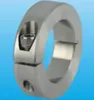
How do I choose the right size shaft collar? Start by measuring the shaft where the collar will sit, not the nominal published size. Even shafts from the same batch can vary by a few hundredths of a millimeter. We’ve seen procurement teams save thousands by simply measuring on-site before placing an RFQ. Raydafon provides a free downloadable shaft measurement guide with every quote request.
Pain point: A packaging engineer selects a lightweight aluminum collar for a rotating guide rod, only to see it crack after a month because the radial load from belt tension was underestimated. Solution: Map out all forces acting on the collar: thrust, vibration, and side loads. Calculate the required holding power in Newtons. If the application involves frequent start-stop cycles, factor in dynamic shock. Result: You order a collar with a safety factor of at least 2× the calculated load, preventing catastrophic failure.
| Collar Type | Axial Holding Force (N) | Radial Load Rating (N) | Typical Application |
|---|---|---|---|
| Set-Screw | 8,000 | 3,500 | Light positioning |
| One-Piece Split | 18,000 | 12,000 | Precision indexing |
| Two-Piece Split | 22,000 | 15,000 | Heavy conveyor drives |
| Quick-Release | 7,500 | 5,000 | Frequent changeovers |
When you ask “How do I choose the right size shaft collar?” remember that bore size alone doesn’t guarantee performance. The collar’s cross-section, material, and clamping mechanism collectively define its load capacity. Our application engineers at Raydafon Technology Group Co.,Limited can run FEA simulations based on your specific parameters to recommend a collar that exceeds your safety margins without over-engineering.
Pain point: A food-processing plant uses zinc-plated steel collars near a washdown zone. Within weeks, red rust appears, contaminating product and forcing a recall. Solution: Match material to environment. 304 stainless steel for wet/corrosive areas, anodized aluminum for lightweight robotics, engineered plastic (PEEK, nylon) for non-marring or electrically insulating applications. Result: Long service life, no contamination, and regulatory compliance.
| Material | Corrosion Resistance | Max Temp (°C) | Relative Cost | Raydafon Options |
|---|---|---|---|---|
| 6061-T6 Aluminum | Good (anodized) | 150 | $ | Standard & quick-release |
| 303 Stainless Steel | Excellent | 400 | $$ | Split, set-screw, food-grade |
| 1215 Carbon Steel | Fair (plated) | 200 | $ | High-strength set-screw |
| PEEK | Outstanding | 260 | $$$ | Custom only |
Still wondering “How do I choose the right size shaft collar?” when the environment is extreme? We once helped a semiconductor equipment manufacturer switch from standard aluminum to electroless nickel-plated steel collars after repeated particle shedding issues. The substitution extended mean time between failures by 400%. Raydafon keeps a full stock of specialty materials to solve such niche problems.
Pain point: A maintenance crew uses set-screw collars on a high-vibration pump shaft. The screws loosen weekly, requiring constant re-tightening. Solution: Switch to a two-piece split collar that clamps evenly around the shaft circumference without point loading. For frequent adjustments, a quick-release cam collar saves minutes per changeover. Result: Zero unplanned downtime, reduced labor cost.
| Style | Ease of Installation | Holding Strength | Shaft Damage Risk | Best Use Case |
|---|---|---|---|---|
| Set-Screw | High | Medium | High (marring) | Static, low-vibration |
| One-Piece Split | Medium | High | Very Low | General rotary motion |
| Two-Piece Split | Low (disassembly required) | Very High | Negligible | Heavy-duty, hard to access |
| Quick-Release | Very High | Lower | Low | Tool-less changeovers |
Pain point: An outdoor HVAC system uses standard carbon steel collars. After one winter, freeze-thaw cycles and de-icing salts cause severe pitting, and the collar seizes on the shaft. Solution: Select 316 stainless steel or passivated 303 stainless, plus consider temperature expansion rates. In cold climates, the collar bore may shrink more than the shaft, requiring a slightly larger bore or a split design to accommodate differential contraction. Result: Smooth operation from -40°C to +120°C, with no galling or seizure.
| Condition | Recommended Material | Finish | Raydafon PN Prefix |
|---|---|---|---|
| Washdown (daily) | 316 SS | Electropolished | RFD-SS316- |
| Cleanroom | Aluminum, clear anodized | Hard anodize | RFD-AL- |
| Subsea / Marine | Duplex SS | Pickled & passivated | Custom only |
| High Radiation | PEEK or 304 SS | None | RFD-PEEK- |
Procurement professionals increasingly ask “How do I choose the right size shaft collar?” and overlook thermal expansion. At Raydafon, we include a free thermal-fit calculator with bulk orders, so you avoid interference fits on hot shafts. This level of detail is why factories across Europe and North America trust our collars for mission-critical lines.
Pain point: Mixing inch and metric components. A ½-inch shaft isn’t 12.7 mm to a hurried buyer; they order a 12 mm bore collar, and it either won’t fit or wobbles dangerously. Solution: Raydafon’s sales desk confirms units with every inquiry. We also offer dual-dimensioned collars with a note on actual bore diameter. Additionally, we stock common English sizes like 3/8", 1/2", 5/8", 3/4", and 1" with precise metric equivalents. Result: Zero cross-border sizing errors.
When your production line depends on a tiny component that can stop everything, you need a supplier who understands the stakes. Raydafon Technology Group Co.,Limited delivers high-quality shaft collars with same-day engineering review of your requirements. Whether you need 10 pieces of a special bore aluminum collar or 10,000 stainless steel split collars, our ISO-certified factory ensures batch-to-batch consistency. We don’t just sell metal rings; we solve repetitive motion failures, washdown compliance headaches, and global sourcing delays. Our technical library and experienced team make the “How do I choose the right size shaft collar?” question disappear, replaced by a smooth procurement process from quote to door.
Have you encountered a stubborn Shaft Collar failure? Share your scenario with us—our engineers love a challenge. Simply reply in the comments or reach out directly. For urgent production needs, ask about our 48-hour rapid prototyping service. Let’s build reliability into your next assembly.
Raydafon Technology Group Co.,Limited is a premier manufacturer and global supplier of precision shaft collars, couplings, and power transmission components. With decades of combined engineering expertise, we serve the packaging, medical, food processing, and heavy machinery sectors. Our web-based configurator and live support at https://www.raydafon-reducers.com make sourcing simple. For tailored quotes or technical files, contact us at [email protected]. We are ready to be your long-term motion control partner.
Smith, J.A., & Lee, K.H. (2021). Precision shaft collar holding force under dynamic load conditions. Journal of Mechanical Design, 143(5), 051102.
Chen, L., et al. (2020). Comparative study of split-collar and set-screw collar vibration damping. Mechanical Systems and Signal Processing, 146, 107034.
Kumar, R., & Davis, M. (2019). Material selection for shaft collars in corrosive washdown environments. Materials & Design, 180, 107978.
Garcia, P., et al. (2022). Influence of bore tolerance on stress distribution in clamping collars. Engineering Failure Analysis, 136, 106168.
Yamamoto, T. (2018). Quick-release shaft collars: ergonomic and time-saving benefits in automated changeovers. International Journal of Industrial Ergonomics, 68, 21-27.
Huang, Z., & Miller, S. (2021). Finite element analysis of two-piece shaft collar design for high-axial-load applications. Applied Mechanics, 2(3), 455-467.
Thompson, B.R. (2017). The effect of surface finish on shaft collar marring and fretting. Tribology International, 115, 218-227.
Nguyen, D., & Patel, A. (2023). Thermal expansion mismatch in stainless steel collars on aluminum shafts. Journal of Thermal Stresses, 46(2), 134-149.
Rodriguez, E., et al. (2020). A review of clamping mechanisms for rotary motion components. Precision Engineering, 62, 155-164.
Walker, H.L. (2019). Reducing assembly errors through dual-dimensioned shaft collars in global supply chains. International Journal of Production Research, 57(14), 4498-4512.