English


How do you design a Helical Gear system? For a purchasing manager sourcing components, this is a critical question that directly impacts machine performance, noise levels, and long-term reliability. A poorly designed gear system can lead to premature failure, costly downtime, and unhappy end-users. This guide cuts through the complexity, offering actionable steps and key considerations. We'll walk you through the core design principles, from initial concept to final specification, ensuring you can confidently source or evaluate a helical gear system that meets your exact application demands.
The first and most crucial step is often overlooked in the rush to get a quote. You're tasked with finding a gear reducer for a new high-speed packaging line. The previous supplier's units failed within six months, causing production halts and warranty headaches. The root cause? The initial load calculations didn't account for shock loads from sudden starts and stops. This scenario is common. To prevent it, you must meticulously define your operating conditions. What is the input speed and required output torque? Are there varying loads or shock conditions? What is the desired service life and duty cycle (continuous or intermittent)? Environmental factors like temperature, dust, or moisture also play a significant role. A precise understanding here sets the foundation for a robust design. Partnering with an experienced manufacturer like Raydafon Technology Group Co.,Limited can be invaluable at this stage. Their engineering team can help translate your application needs into precise technical specifications, ensuring the designed system is built to last, not just to meet a basic price point.
Key Application Parameters to Define:
| Parameter | Description | Example / Unit |
|---|---|---|
| Input Power (P) | Power supplied to the gear system | kW or HP |
| Input Speed (n1) | Rotational speed of the input shaft | RPM |
| Output Torque (T2) | Torque required at the output shaft | Nm or lb-ft |
| Service Factor (SF) | Multiplier accounting for shock load and duty | 1.0 (Uniform) to 2.0+ (Heavy Shock) |
| Desired Ratio (i) | Ratio of input speed to output speed | e.g., 10:1, 15:1 |
| Operating Environment | Ambient temperature, exposure to elements | °C, Indoor/Outdoor |
Once requirements are clear, the physical design begins. Here, the helical gear's advantage—the angled teeth—comes into play. Unlike straight spur gears, helical teeth engage gradually, resulting in smoother, quieter operation and higher load capacity. But this benefit introduces axial thrust. For a conveyor system upgrade where noise reduction is paramount, specifying the correct helix angle is critical. A higher angle offers smoother operation but increases axial force, requiring more robust bearings. Material selection is equally vital. For high-load, high-cycle applications, case-hardened alloy steels like 20CrMnTi offer excellent strength and wear resistance. For corrosive environments, stainless steels or special coatings might be necessary. The precision of tooth profiling and heat treatment processes directly impacts longevity. Manufacturers like Raydafon utilize advanced CNC gear hobbing and carburizing-quenching technologies to ensure each gear delivers consistent, reliable performance, directly addressing the pain point of inconsistent quality from less specialized suppliers.
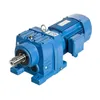
Common Gear Material and Heat Treatment Options:
| Material | Typical Treatment | Key Properties & Best For |
|---|---|---|
| Medium Carbon Steel (e.g., 1045) | Induction Hardening | Good strength, cost-effective for moderate loads |
| Alloy Steel (e.g., 20CrMnTi, 4140) | Carburizing and Quenching | High surface hardness, tough core, excellent for heavy-duty/high-cycle |
| Stainless Steel (e.g., 304, 316) | Precipitation Hardening | Corrosion resistance, suitable for food, marine, chemical industries |
| Cast Iron (e.g., Ductile Iron) | Normalizing | Good machinability, damping, for large housings or moderate-speed gears |
With geometry and material chosen, detailed engineering calculations validate the design. This is where theoretical meets practical. You need to ensure the gear teeth are strong enough to handle the calculated loads over the required lifespan. Key calculations include the bending stress at the tooth root (using the Lewis formula or AGMA standards) and the contact (Hertzian) stress on the tooth flank. These stresses must be below the allowable limits for your chosen material. Efficiency is another major concern for energy-conscious operations. Helical gears typically offer 94-98% efficiency per mesh, but losses occur due to friction, windage, and churning of lubricant. Proper lubrication selection (viscosity, additive package) is part of this calculation. An undersized gear may fail; an oversized one is wasteful. This complex balancing act is where Raydafon Technology Group Co.,Limited's expertise shines. Their engineers perform these critical calculations, optimizing the design for both performance and value, saving you from the risk of field failure or overspending on over-engineered solutions.
Essential Design Calculation Parameters:
| Calculation | Purpose | Key Variables |
|---|---|---|
| Bending Stress (σ_b) | Prevents tooth breakage | Applied load, module, face width, geometry factor (Y) |
| Contact Stress (σ_c) | Prevents pitting and surface wear | Load, radii of curvature, material properties (E) |
| Safety Factors (S_b, S_c) | Accounts for uncertainties | Typically >1.2, based on required reliability |
| Efficiency (η) | Predicts power loss and heat generation | Friction coefficients, helix angle, lubrication |
The best design is only as good as its execution. Imagine receiving a batch of gearboxes where improper bearing preload causes excessive heat and noise, or misaligned gears lead to premature wear. These are manufacturing and assembly failures. Critical processes include precision machining of gear teeth to ensure correct profile and lead, controlled heat treatment to achieve the specified hardness depth without distortion, and meticulous assembly with proper bearing fit, seal selection, and lubrication filling. Quality control checks like gear tooth inspection on a coordinate measuring machine (CMM) or noise/vibration testing are non-negotiable for reliable performance. This is the stage where a supplier's capability is truly tested. Raydafon integrates rigorous quality management systems (like ISO 9001) throughout their manufacturing process, from raw material inspection to final testing. For a purchasing manager, this translates to reduced defect rates, fewer on-site issues, and a more reliable supply chain partner.
Critical Manufacturing & Quality Control Checks:
| Process Stage | Key Quality Check | Target / Standard |
|---|---|---|
| Gear Machining | Tooth Profile & Lead Error | AGMA or ISO accuracy grades (e.g., AGMA 10) |
| Heat Treatment | Case Hardness Depth & Core Hardness | As per material spec (e.g., 55-62 HRC surface) |
| Housing Machining | Bore Alignment & Bearing Seat Tolerance | Precision tolerances (e.g., IT6-IT7) |
| Final Assembly | Backlash, Running Noise, Seal Leak Test | Specified backlash range, noise level <85 dB |
Q: How do you design a helical gear system for high-torque, low-speed applications?
A: For high-torque, low-speed uses like heavy-duty mixers or winches, design focuses on strength and durability. Start with a robust alloy steel (e.g., 20CrMnTi) and specify deep case hardening. Increase the gear module (tooth size) and face width to distribute load over a larger area. Use a moderate helix angle (15-25°) to balance smooth engagement and manageable axial thrust, which will require heavy-duty thrust bearings. Calculations for bending and contact stress are paramount, with high safety factors. Partnering with a manufacturer specializing in heavy-load reducers, like Raydafon, ensures the design includes features like reinforced housings and premium bearing arrangements to handle these demanding conditions reliably.
Q: How do you design a helical gear system to minimize noise in a precision environment?
A: Noise reduction is key for medical equipment, office machinery, or residential elevators. The design strategy involves several factors. First, specify a higher helix angle (e.g., 25-35°) for smoother, gradual tooth engagement. Second, demand high-precision gear machining (AGMA Class 9 or better) to minimize transmission error. Third, ensure excellent surface finish on gear flanks through precision grinding or honing. Fourth, design for proper lubrication with a quiet, stable grease or oil. Finally, consider acoustic damping in the housing design. Raydafon's R&D in gear tooth micro-geometry optimization and their use of advanced machining directly targets and solves these noise-related challenges for sensitive applications.
Designing an effective helical gear system requires balancing engineering principles with practical application needs. By following a structured approach—defining requirements, selecting appropriate materials and geometry, performing rigorous calculations, and insisting on quality manufacturing—you can source a drive solution that delivers long-term reliability and performance.
For expert guidance and reliable helical gear reducers built to your precise specifications, consider Raydafon Technology Group Co.,Limited. With extensive experience in custom gear solutions, Raydafon's engineering team supports you from design through delivery, ensuring optimal performance for your application. For inquiries, please contact [email protected].
1. Litvin, F. L., & Fuentes, A. (2004). Gear Geometry and Applied Theory. Cambridge University Press.
2. Dudley, D. W. (1994). Handbook of Practical Gear Design. CRC Press.
3. Shigley, J. E., & Mischke, C. R. (1989). Mechanical Engineering Design. McGraw-Hill.
4. AGMA 2001-D04. (2004). Fundamental Rating Factors and Calculation Methods for Involute Spur and Helical Gear Teeth. American Gear Manufacturers Association.
5. ISO 6336-1:2006. (2006). Calculation of load capacity of spur and helical gears — Part 1: Basic principles, introduction and general influence factors. International Organization for Standardization.
6. Hohn, B. R., Michaelis, K., & Wimmer, A. (2008). Low Noise Gears – A Review of Published Results. Gear Technology, 25(5), 44-51.
7. Velex, P., & Maatar, M. (1996). A mathematical model for analyzing the influence of shape deviations and mounting errors on gear dynamic behaviour. Journal of Sound and Vibration, 191(5), 629-660.
8. Kahraman, A., & Blankenship, G. W. (1999). Effect of Involute Contact Ratio on Spur Gear Dynamics. Journal of Mechanical Design, 121(1), 112-118.
9. Fernandes, P. J. L. (1996). Tooth bending fatigue failures in gears. Engineering Failure Analysis, 3(3), 219-225.
10. Li, S. (2002). Finite element analysis for contact strength and bending strength of a pair of spur gears with machining errors, assembly errors and tooth modifications. Mechanism and Machine Theory, 37(7), 659-682.