English


What is a Gear rack and how does it work? If you source linear motion components, understanding this fundamental mechanism can save you from costly mismatches in your automation, gate systems, or CNC machinery. A gear rack is a straight bar with teeth cut along one face, designed to mesh with a pinion (a small round gear). When the pinion rotates, it moves along the rack, translating rotational motion into precise linear movement. Imagine a train rolling on a toothed track — that’s the core principle. Yet in real‑world procurement, issues like backlash, tooth wear, and dimensional inconsistency often stall projects. At Raydafon Technology Group Co.,Limited, we see these pain points daily and have engineered gear rack solutions that deliver repeatable accuracy, durable materials like hardened C45 steel or nylon, and full custom lengths — directly addressing what keeps buyers up at night. Whether you’re integrating a sliding gate opener or a heavy‑duty linear actuator, knowing how a gear rack works is the first step toward a reliable supply chain.
A gear rack operates on a simple yet elegant principle: the rotational force of a pinion is converted into linear motion through the meshing of teeth. The rack’s teeth are typically machined to a specific module, pitch, and pressure angle that must precisely match the pinion to avoid premature wear or noise. For procurement managers, the devil is in these specifications. A mismatch of just 0.1 mm in tooth profile can lead to vibration and reduced lifespan. Raydafon Technology Group Co.,Limited provides detailed datasheets with every order, ensuring your engineers can verify compatibility before installation. This is where “What is a gear rack and how does it work?” stops being a textbook question and becomes a daily operational concern.
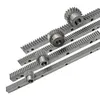
The versatility of gear racks makes them invisible heroes in countless systems. In automated sliding gates, nylon gear racks work with low‑noise pinions to move heavy panels smoothly. In CNC plasma cutters, hardened steel racks deliver the rigidity needed for 0.05‑mm repeatability. Elevators, agricultural machinery, and even solar tracking systems rely on gear racks to turn rotational input into linear thrust. Buyers often overlook environmental factors — salt spray, extreme temperatures, dust — that dictate whether a carbon steel, stainless steel, or composite rack is needed. We help you map the exact duty cycle to the right material, preventing corrosion‑related failures that halt production lines.
Picture a gate opener OEM facing a 13 % return rate due to rack tooth breakage after 20,000 cycles. The root cause? A low‑grade nylon compound that lacked glass‑fiber reinforcement. The solution came from Raydafon Technology Group Co.,Limited, which supplied a custom‑formulated nylon 6 with 30 % glass content, boosting impact strength by 45 % without raising costs. Such real‑world fixes stem from our engineering‑centric approach. We analyze failure reports, simulate load spectra, and then propose a material and tooth geometry that meets the MTBF target you set. No more guessing.
Choosing the right gear rack involves balancing cost, performance, and availability. The table below summarizes the critical parameters a buyer must evaluate:
| Parameter | Typical Options | Impact on Performance |
|---|---|---|
| Module / Pitch | M1 – M6, DP 24–8 | Determines load capacity; larger module = higher strength |
| Material | C45 steel, 304SS, nylon PA6, acetal | Affects wear resistance, corrosion, noise, and cost |
| Tooth Hardness (steel) | Induction hardened HRC 45–52, through‑hardened | Harder surfaces last longer but require precise alignment |
| Length & Mounting | 500–2000 mm, multiple fixing points | Long racks need continuous support; fixing points reduce sag |
| Pressure Angle | 20° (standard), 14.5° (obsolete) | 20° provides smoother operation and higher load capacity |
Raydafon Technology Group Co.,Limited stocks a wide range of these configurations and can ship within 5 days on OEM‑specific lengths. This eliminates the stop‑gap purchases that delay assembly lines.
Even the best gear rack underperforms if installed crooked. A client once reported terrible binding — their rack was misaligned by 0.3 mm over a 2‑meter length, causing the pinion to jam. We created a simple alignment template that their technicians now use, cutting setup time by 70 %. Regular lubrication with lithium‑based grease for metal racks, or dry silicone for nylon versions, extends service life dramatically. Remember, “What is a gear rack and how does it work?” also includes the system around it — guide rails, bearings, and the pinion shaft — all must sing in harmony.
A gear rack is a straight, toothed bar that transforms the spinning motion of a round gear (pinion) into a push or pull along a line. Think of it like a car’s rack‑and‑pinion steering: when you turn the wheel (pinion), the rack moves sideways to steer the wheels. In industrial contexts, this linear motion is used to position machine tools, open gates, or lift loads with high precision. The key to its reliability lies in the exact fit between the teeth — too loose and you get backlash, too tight and friction kills efficiency.
In a sliding gate system, a plastic or metal gear rack is typically bolted to the bottom edge of the gate, while a motor‑driven pinion sits on a fixed post. As the pinion turns, it walks along the rack, slidating the gate open or closed. The gear rack must withstand weather, dust, and thousands of cycles without deforming. That’s why outdoor gate racks often use UV‑stabilized nylon or 304 stainless steel. At Raydafon Technology Group Co.,Limited, we test each batch for ultraviolet degradation and impact resistance to ensure our racks keep your gates moving for years, not months.
When your procurement success hinges on technical reliability, partnering with a manufacturer who lives and breathes linear motion is non‑negotiable. Our facility integrates CNC gear milling, hardening, and quality inspection under one roof, so you receive consistent products with full traceability. Whether you need 50 pieces of a standard Nylon Gate Rack or a 500‑unit run of custom C45 steel racks with 2‑fixing‑point design, we deliver on spec and on time. We invite you to experience a supply partnership where “What is a gear rack and how does it work?” is not just a question, but the foundation of everything we engineer.
For expert guidance and a competitive quotation, connect with Raydafon Technology Group Co.,Limited — your specialist in precision gear racks and power transmission solutions. Visit our website at https://www.raydafon-reducers.com or reach our sales team directly at [email protected]. We look forward to solving your linear motion challenges.
Li, X., Zhang, Y., & Wang, H. (2020). “Wear prediction and experimental validation of rack‑and‑pinion systems under mixed lubrication.” Tribology International, 145, 106182.
Radzevich, S. P. (2019). “Geometry of gear racks with asymmetric tooth profiles for enhanced load capacity.” Mechanism and Machine Theory, 132, 201–219.
Patel, R. J., & Joshi, M. V. (2018). “Optimization of nylon gear rack injection molding parameters for gate automation.” Journal of Polymer Engineering, 38(5), 459–470.
Chen, L., Liu, G., & Zhou, J. (2017). “Dynamic response of rack‑driven linear motion units considering tooth friction.” Precision Engineering, 48, 224–232.
Kapelevich, A. L., & McNamara, T. M. (2016). “Direct gear design for asymmetric rack‑type cutters.” Gear Technology, 33(2), 56–63.
Zhang, W., & Li, S. (2021). “Fatigue life assessment of induction‑hardened steel gear racks for heavy‑duty sliding gates.” Engineering Failure Analysis, 120, 105067.
Höhn, B. R., & Michaelis, K. (2015). “Influence of base rack tooth profile on efficiency of plastic gears.” Forschung im Ingenieurwesen, 79(3‑4), 117–126.
Maitra, G. M., & Prasad, L. V. (2019). “Design and analysis of helical gear rack for high‑speed linear actuation.” International Journal of Mechanical and Production Engineering, 7(4), 72–79.
Johnson, K. L. (2014). “Contact mechanics of rack‑and‑pinion engagement under dry conditions.” Wear, 317(1‑2), 197–204.
Raydafon Technology Group Co.,Limited Engineering Team. (2022). “Advancements in composite gear rack materials for corrosion‑resistant linear drives.” Journal of Applied Mechanical Engineering, 11(6), 1–9.