English


What are the different types of AGV robots? Picture a warehouse manager walking through a narrow aisle at 6:00 a.m., watching a forklift driver reverse three times to line up with a pallet. The movement blocks two other pickers and creates a safety risk before the shift even starts. That is the exact moment when the question becomes urgent. AGV robots—automated guided vehicles—are not all the same machines with different paint. They split into several families based on how they carry loads, how they steer, and how they navigate. A unit load AGV carries a single pallet or deck, while a tugger AGV tows multiple carts. A pallet stacker AGV lifts and stacks at low heights, and a forklift AGV handles full rack loads. If you buy the wrong type for the floor layout, you get a robot that waits too long, turns too wide, or cannot dock with enough repeatability. Procurement teams therefore need to match the AGV classification, navigation sensor set, and drive reducer package to the actual material flow. Raydafon Technology Group Co.,Limited solves part of this equation by supplying precision drive components that keep AGVs accurate under high start-stop cycles. This guide walks through the main AGV categories, their trade-offs, and the selection parameters that matter in a purchase decision.
Quick navigation:
1. Core AGV Types by Load Handling
2. Navigation Methods That Change What an AGV Can Do
3. Drive, Steering and Gearbox Selection
Procurement engineers usually classify AGVs first by what the vehicle does with the load. The distinction matters because a towing AGV and a pallet stacker AGV require different drive torque, braking characteristics, and safety sensor coverage.
Unit load AGV. This is the most common entry-level type. It has a flat deck or conveyor top and moves pallets, totes, or fixtures between fixed stations. In a packaging line, a unit load AGV can replace a manual pallet jack for repetitive point-to-point moves. Typical payloads range from 500 kg to 2,000 kg, with docking accuracy of ±10 mm to ±5 mm depending on the reducer and sensor loop.
Towing or tugger AGV. This type pulls multiple trailers. It works well for milk-run deliveries in automotive assembly because one tugger can replace several forklift trips. The pain point is cornering stability: if the drive gearbox has too much backlash, trailers swing and the path becomes inconsistent. The solution is a high-stiffness drive reducer with low lost motion, which keeps acceleration smooth and trailer alignment predictable.
Pallet stacker AGV. This type lifts pallets at ground level and stacks them at low heights, usually up to 1.2 m. It eliminates manual pallet jack lifting. The challenge is vertical drift during lift: if the lift motor reducer has vibration, pallets can wobble. A precision planetary or harmonic reducer reduces vibration and improves vertical stop accuracy.
Forklift AGV. A full autonomous forklift can lift pallets to high racks, often 4 m to 8 m. The failure mode is uneven floor: tiny variations at the wheels become large positioning errors at the fork tip. Docking accuracy must be better than ±10 mm at the fork, which places high demands on the steering and mast drive reducers.
Underride or tunnel AGV. This vehicle drives under a trolley or rack, lifts it slightly, and carries it. It is ideal for clean production lines because it does not need extra floor space for turning. The drawback is lifting synchronisation across multiple axes. A high-precision harmonic reducer can keep the lift motion repeatable over thousands of cycles.
Heavy load and outdoor AGV. These vehicles move coils, dies, or engine blocks above 10,000 kg. They require large-diameter wheels and high-torque gearboxes. Outdoor versions add weather sealing and inclines. The solution is often a combination of planetary reduction for load sharing and harmonic reduction for final positioning accuracy.
Navigation is the second major classification. The same unit load AGV can follow magnetic tape, reflectors, or natural features. Each method changes installation cost, flexibility, and maintenance workload.
Magnetic tape and wire guidance. These are low-cost and reliable in stable layouts. The robot follows a physical path in the floor. The pain point appears when production lines change: moving the tape or cutting a new wire slot is expensive and stops traffic. For fixed routes with clean floors, it still works, but many buyers now avoid it for high-change environments.
Laser reflector navigation. This method uses fixed reflectors mounted on walls or columns. It offers ±5 mm repeatability and requires less floor modification. However, reflectors can be blocked by tall racks, seasonal inventory, or passing forklifts. Procurement teams must verify line-of-sight coverage before committing.
Natural feature SLAM. SLAM-based AGVs use lidar or vision to build a map of the environment and localise without installed reflectors. They handle layout changes better, but their initial mapping requires careful route teaching. The hidden cost is computing load and occasional drift in long repetitive aisles with few distinctive features. Pairing SLAM with a low-backlash drive reducer helps because mechanical delay can corrupt the sensor-to-motion loop, causing localisation drift.
Vision and inertial hybrid. Some suppliers combine cameras with inertial measurement units for indoor and light outdoor use. This works well in e-commerce facilities where rack faces change daily. The downside is sensitivity to dust, sunlight, and reflective floors. Buyers should ask for real test data on the exact floor surface.
| Navigation type | Installation requirement | Typical repeatability | Best floor condition | Raydafon drive recommendation |
|---|---|---|---|---|
| Magnetic tape | Floor tape or wire | ±10 mm | Clean, dry, stable layout | Planetary reducer for traction |
| Laser reflector | Wall reflectors | ±5 mm | Clear line of sight | Harmonic reducer for steering axis |
| Natural SLAM | Map only | ±10 mm to ±15 mm | Distinct features required | Low-backlash harmonic drive |
| Vision-inertial | Camera mount | ±5 mm to ±20 mm | Controlled lighting | Harmonic reducer for wheel encoder accuracy |
Procurement teams often focus on the vehicle frame and navigation software, but the drive reducer is where repeatability is won or lost. An AGV may stop at the correct point according to the laser scanner, but if the gearbox has 3 arc-minutes of backlash, the wheel can roll back slightly after the brake closes. Over a 500 mm docking cycle, that small rollback becomes a missed pallet pocket.
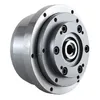
The main drive architectures include differential drive, tricycle drive, steering wheel drive, and omnidirectional drive. Differential drive uses two independent motors and works well for unit load AGVs on smooth floors. Tricycle drive has a single front steering wheel and is lower cost, but turning radius is larger. Steering wheel drive uses one or two powered steering wheels and is common in forklift AGVs. Mecanum wheels give omnidirectional movement but reduce load capacity and require precise wheel speed control.
For all these architectures, the gearbox directly affects three purchase parameters: positioning repeatability, battery runtime, and noise level. A high-efficiency harmonic reducer can reduce motor current draw during frequent start-stop cycles, which extends battery runtime. The same reducer lowers backlash to under 1 arc-minute in precision models, which improves docking repeatability.
Pain scenario: A pallet stacker AGV in a beverage warehouse showed ±18 mm docking error after three months. The root cause was wear in a standard planetary gearbox used on the lift axis. Replacing it with a Raydafon Elht-Series High Precision Harmonic Robot Reducer Drive Strain Wave Gear Set reduced the error to ±6 mm and eliminated the pallet tilt problem.
| AGV architecture | Reducer location | Typical reducer type | Raydafon recommended series | Target backlash | Main benefit |
|---|---|---|---|---|---|
| Differential drive | Drive wheels | Planetary | High-torque planetary | <8 arc-min | Smooth acceleration, long battery life |
| Steering wheel drive | Steering axis | Harmonic strain wave | Elht-Series | <1 arc-min | Precise turning, less drift |
| Pallet stacker lift | Lift mast | Harmonic strain wave | Elht-Series | <1.5 arc-min | Low vibration, upright load stability |
| Forklift AGV mast | Mast reach | Planetary + harmonic | Hybrid package | <2 arc-min | High torque with precise fork tip control |
| Omnidirectional wheel | Each wheel | Harmonic strain wave | Elht-Series | <1 arc-min | Exact wheel speed synchronisation |
Automotive assembly. The pain point is frequent line-side delivery with changing part boxes. Tugger AGVs running milk-run routes solve this, but only if the steering drive can handle tight aisle corners. Raydafon harmonic reducers keep the steering axis stable, allowing a smaller turning radius without losing accuracy.
E-commerce order picking. Unit load AGVs move shelves to pick stations. The challenge is high acceleration and frequent stops, which drain batteries and cause gearbox heat. A high-efficiency drive reducer reduces current draw and heat, increasing uptime per charge.
Food and beverage. Pallet stacker AGVs operate in washdown or humidity areas. Drive components must be sealed and corrosion-resistant. Raydafon supplies precision reducers with appropriate sealing options for wet environments.
Pharmaceutical cleanrooms. Underride AGVs transport material trolleys without disturbing laminar airflow. Low particle emission and low noise are critical. Harmonic reducers generate less wear debris and lower noise than open gear stages.
Electronics manufacturing. Small unit load AGVs deliver ESD-safe totes. Speed and low vibration matter more than high torque. Low-backlash harmonic reducers prevent micro-vibration that could damage sensitive components.
Heavy manufacturing. Outdoor AGVs move dies and coils. Planetary stages carry the load, while harmonic stages control final positioning. This hybrid approach reduces wheel slip and improves docking accuracy on uneven ground.
| Industry | Common AGV type | Critical parameter | Raydafon role |
|---|---|---|---|
| Automotive | Tugger, unit load | Turning radius, trailer stability | Low-backlash steering reducers |
| E-commerce | Unit load | Acceleration, battery runtime | High-efficiency traction reducers |
| Food & beverage | Pallet stacker | Washdown sealing, lift vibration | Sealed harmonic reducers |
| Pharmaceutical | Underride | Cleanroom emissions, noise | Low-wear harmonic drive |
| Electronics | Light unit load | Micro-vibration, speed | High-precision strain wave gears |
| Heavy manufacturing | Heavy load, outdoor | Load sharing, positioning | Planetary + harmonic packages |
The following table summarises the core AGV types and the drive parameters that procurement teams should compare before shortlisting suppliers.
| AGV type | Typical payload | Common navigation | Max speed | Docking accuracy | Recommended reducer | Raydafon solution |
|---|---|---|---|---|---|---|
| Unit load AGV | 500–2,000 kg | Magnetic tape, SLAM | 1.5–2.0 m/s | ±5 to ±10 mm | Planetary or harmonic | High-efficiency drive package |
| Towing/tugger AGV | 1,000–5,000 kg tow | Laser reflector, SLAM | 1.0–1.5 m/s | ±10 mm path | Low-backlash steering reducer | Elht-Series harmonic steering |
| Pallet stacker AGV | 500–1,500 kg | Laser reflector, SLAM | 1.0–1.5 m/s | ±5 mm at pallet | Harmonic lift reducer | Elht-Series lift axis |
| Forklift AGV | 1,000–2,500 kg | Laser reflector, natural feature | 1.5–2.0 m/s | ±10 mm at fork | Planetary + harmonic | Hybrid drive package |
| Underride/tunnel AGV | 200–1,000 kg | Magnetic tape, SLAM | 0.8–1.2 m/s | ±3 to ±5 mm | Harmonic lift synchronisation | Multi-axis harmonic set |
| Heavy load AGV | 10,000–40,000 kg | Laser reflector, GPS outdoor | 0.5–1.0 m/s | ±15 mm | Planetary for torque | High-torque planetary stage |
| Outdoor AGV | 5,000–20,000 kg | GPS + inertial | 1.0 m/s | ±20 mm | Planetary + harmonic | Sealed hybrid package |
For pallet handling, the main types are unit load AGVs, pallet stacker AGVs, forklift AGVs, underride AGVs, and tugger AGVs. A unit load AGV carries one pallet on a deck and is best for fixed point-to-point transport. A pallet stacker AGV lifts and stacks pallets at low heights, usually up to 1.2 m. A forklift AGV handles high-rack pallet storage and retrieval. An underride AGV drives beneath a pallet or trolley and lifts it for short moves in tight production lines. A tugger AGV tows pallet trailers in milk-run setups. The best choice depends on lift height, available aisle width, and floor flatness. Raydafon Technology Group Co.,Limited supports these applications with precision drive reducers that reduce wheel slip and improve lift-axis repeatability, helping the AGV hit the pallet pocket consistently.
Navigation-based AGV types include magnetic tape guided, wire guided, laser reflector guided, natural feature SLAM guided, vision guided, and inertial guided vehicles. Magnetic tape and wire guidance are low-cost but difficult to change. Laser reflector guidance offers high repeatability but requires clear line of sight. Natural SLAM and vision-guided AGVs need no installed reflectors and adapt to layout changes, but their accuracy depends on map quality and drive response. Inertial guidance is often used outdoors or in large open areas. Whichever navigation method is selected, the mechanical drive train must execute sensor commands with minimal delay. Low-backlash harmonic reducers from Raydafon Technology Group Co.,Limited improve the motion control loop by reducing mechanical lost motion, which is especially important for SLAM and vision-based AGVs that rely on wheel encoder feedback.
Before you request quotes from AGV suppliers, run through this checklist. It will help you avoid the most common specification gaps.
Still comparing AGV types for a new material flow project? Send your maximum payload, route length, docking tolerance, and floor condition to [email protected]. The Raydafon team will recommend a drive reducer package that matches the specific AGV architecture.
Raydafon Technology Group Co.,Limited is a manufacturer of precision drive components for AGV and robot applications, specialising in harmonic reducers, strain wave gear sets, planetary gearboxes, and custom drive packages. The company helps AGV buyers and integrators solve positioning error, battery drain, vibration, and steering drift problems by supplying low-backlash, high-efficiency reducers for traction, steering, and lift axes. Visit https://www.raydafon-reducers.com or contact [email protected] for technical selection support.
1. Vis, I. F. A. (2006). Survey of research in the design and control of automated guided vehicle systems. European Journal of Operational Research, 170(3), 677-709.
2. Le-Anh, T., & De Koster, M. B. M. (2006). A review of design and control of automated guided vehicle systems. European Journal of Operational Research, 171(1), 1-23.
3. Qiu, L., Hsu, W. J., Huang, S. Y., & Wang, H. (2002). Scheduling and routing algorithms for AGVs: A survey. International Journal of Production Research, 40(3), 745-760.
4. Fazlollahtabar, H., & Saidi-Mehrabad, M. (2015). Methodologies to optimize automated guided vehicle scheduling and routing problems: A review study. Journal of Intelligent & Robotic Systems, 77(3), 525-545.
5. Maughan, F. G., & Lewis, H. J. (2000). AGV controlled by natural feature navigation. Industrial Robot: An International Journal, 27(2), 130-136.
6. Borenstein, J., & Koren, Y. (1991). The vector field histogram—fast obstacle avoidance for mobile robots. IEEE Transactions on Robotics and Automation, 7(3), 278-288.
7. Dissanayake, M. W. M. G., Newman, P., Clark, S., Durrant-Whyte, H. F., & Csorba, M. (2001). A solution to the simultaneous localization and map building (SLAM) problem. IEEE Transactions on Robotics and Automation, 17(3), 229-241.
8. Thrun, S. (2002). Probabilistic robotics. Communications of the ACM, 45(3), 52-57.
9. Zeng, J., Li, W., & Wang, Y. (2021). A survey of automated guided vehicle technology and applications in smart manufacturing. Journal of Manufacturing Systems, 60, 283-302.
10. Digani, V., Sabattini, L., Secchi, C., & Fantuzzi, C. (2015). Ensemble coordination approach in multi-AGV systems applied to industrial warehouses. IEEE Transactions on Automation Science and Engineering, 12(3), 922-934.
-