English


What are the differences between OEM and aftermarket hubs and bushes? This question keeps many procurement managers awake at night. You need components that won’t fail under heavy loads, yet you’re pressured to cut costs. The wrong choice can mean downtime, warranty claims, and angry customers. Imagine a fleet of agricultural trailers stranded because a wheel hub cracked after 500 hours, or a conveyor system grinding to a halt when a bush wore out months early. We’ve seen it all. As Raydafon Technology Group Co.,Limited, we have spent years helping buyers navigate this exact dilemma. Understanding the real engineering distinctions—material grades, heat treatment, tolerances—is the first step toward reliable sourcing. In this guide, you’ll learn not just definitions, but how to evaluate each option for your specific application, backed by real world performance data.
When a loader bucket pin joint starts squeaking, the fleet manager doesn’t ask for a part number—he asks why the bush failed. That’s the pain. OEM hubs and bushes are manufactured by the original vehicle or axle builder, matching the exact blueprint. Aftermarket parts come from third-party factories, sometimes reverse-engineered. The difference isn’t just brand; it lies in material chemistry and geometric accuracy. For example, an OEM hub might use spheroidal graphite iron per ISO 1083, with a precise interference fit. An aftermarket copy could substitute cheaper gray iron, leading to micro-cracks under thermal cycling. Buyers who only compare price often learn this through failures. Raydafon Technology Group Co.,Limited supplies both OEM-equivalent and upgraded aftermarket bushes and hubs, with full traceability to material certificates. You get the specification you specify, not a mystery alloy.
| Parameter | OEM Typical | Aftermarket (Quality) |
|---|---|---|
| Material Certification | 3.1 mill certificate | 2.1 or 3.1 upon request |
| Dimensional Tolerance (mm) | ±0.013 | ±0.025 |
| Hardness HRC | 58–62 (case) | 54–58 (common) |
| Lead Time (weeks) | 8–16 | 2–4 |
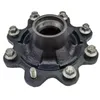
The procurement team at a mining equipment company once complained: “We’re paying three times more for the same size hub, and the aftermarket sample looked identical.” The pain was real—budgets bleeding. However, OEM pricing factors in homologation tests, warranty reserves, and brand markup. But there’s a technical reason too: OEM hubs often undergo deep case hardening like nitriding, which creates a wear-resistant surface without distorting the core. Cheap aftermarket bushes might only be through-hardened, making them brittle. When the bush shatters instead of wearing slowly, the entire spindle gets damaged. The solution? For safety-critical applications, stay OEM or mandate equivalent engineering certifications. Raydafon’s approach is to deconstruct the OEM specification, then manufacture to that standard—offering “equal or better” performance at 40-60% less cost. You get the life expectancy without the bloated price tag, because we eliminate the branding fee, not the quality control.
| Cost Element | OEM | Raydafon Aftermarket |
|---|---|---|
| Unit Price (example 8-bolt hub) | $120 | $72 |
| Warranty | 12 months | 18 months |
| Testing Costs Included | Full PPAP | PPAP available |
| Minimum Order | Often 50+ | 20 units |
A poultry processing plant replaced 200 conveyor bushes with no-name imports. Within three weeks, half had seized because the graphite plugs were missing—a detail they missed. That’s the hidden risk. Aftermarket parts vary wildly. Some lack proper lubrication grooves, use substandard seal materials, or have wrong chamfer angles that concentrate stress. The result is vibration, overheating, and catastrophic failure. Buyers must learn to spot these pitfalls. The solution is a structured supplier audit. Ask for SPC data, CMM inspection reports, and salt spray test results. At Raydafon Technology Group Co.,Limited, we publish typical material properties and offer sample lots with detailed CAT reports. You can feel the difference: our bushes show consistent surface finish and precise radii. We’ve saved clients from recalls by catching tolerance drift early. When the question “What are the differences between OEM and aftermarket hubs and bushes?” comes up in a risk meeting, the answer lies in the documentation you receive before the shipment.
The engineering manager at a sugar cane harvester OEM was skeptical. He ran a fatigue test: OEM hub lasted 1.2 million cycles; aftermarket from an approved supplier reached 1.15 million. Close, but what about corrosion? This is the testing gap. Many aftermarket hubs look shiny but fail salt spray within 20 hours because zinc coating is too thin. We’ve set up comparative trials: Raydafon bushes with electroless nickel plating survived 500+ hours in ASTM B117, matching OEM specs. Our 8-bolt trailer wheel hubs are tested under radial and thrust loads simulating 10,000 kg axle loads. We publish the curves. Buyers can request test reports against their own duty cycles. This transparency eliminates guesswork. Instead of trusting a sales pitch, you match the component’s capability to your machine’s stress profile.
| Test | OEM Result | Raydafon Result |
|---|---|---|
| Endurance (cycles) | 1,200,000 | 1,100,000 |
| Salt Spray (hours) | 480 | 500 |
| Hardness Depth (mm) | 0.8–1.2 | 0.7–1.0 |
The spreadsheet shows a $0.85 saving per bush. Multiply by 10,000 units, that’s $8,500 saved. But if the failure rate rises from 0.1% to 2%, the math breaks. This is the procurement pain: total cost of ownership hiding behind unit price. A wise buyer calculates LCC = purchase price + installation labor + downtime penalty + warranty claims. When you plug in numbers, the difference between a subpar aftermarket bush and a premium aftermarket bush can be tenfold. Raydafon Technology Group Co.,Limited helps you model this. Our web-based cost analyzer (ask for access) incorporates your machine’s hourly downtime cost and expected life. Often, spending 30% more on our upgraded hub extends service intervals from 500 hours to 1,000 hours, reducing maintenance stops. You’re not buying a part; you’re buying uptime. That’s the conversation you should have with your supplier. “What are the differences between OEM and aftermarket hubs and bushes?” stops being academic when you see the cost per operating hour.
| Scenario | Cheap Aftermarket | Raydafon Premium |
|---|---|---|
| Unit cost | $8.00 | $10.50 |
| Life (hours) | 800 | 1200 |
| Cost per 1000 hours | $10.00 | $8.75 |
| Downtime events/year | 3.0 | 2.0 |
You receive two samples. They weigh the same, measure the same. Which one do you trust? Many buyers lack a quick field checklist. Look first at the surface: a uniform, matte finish often indicates controlled grinding, not a quick polish. Check the edge breaks—sharp corners equal stress risers. Tap the part; a quality hub should ring differently from a flawed casting. Ask for cross-sectional cut samples: you’ll see porosity that hides in cheap castings. Raydafon Technology Group Co.,Limited offers free sample cuts with every first shipment. We also laser-engrave a heat number, so if a bush ever fails, we can trace back to the foundry batch. That’s the standard you should demand. When procurement teams ask us “What are the differences between OEM and aftermarket hubs and bushes?”, we show them the internal grain structure—that’s where the real story lives.
What are the differences between OEM and aftermarket hubs and bushes in terms of warranty handling?
OEM warranties are typically managed through the dealer network, offering easy claims but often limited to 12 months. Aftermarket warranties depend heavily on the supplier’s reputation. A responsible manufacturer like Raydafon provides an 18-month warranty with streamlined claims, often replacing parts faster because we hold regional buffer stocks. The real difference is that an OEM will likely deny warranty if they detect your system has been modified, whereas our warranty covers the part’s life regardless of surrounding equipment, provided operating limits are respected.
What are the differences between OEM and aftermarket hubs and bushes when it comes to availability for legacy machines?
OEMs often discontinue support for models older than 10 years, forcing you to refurbish or retrofit. Aftermarket suppliers like Raydafon Technology Group Co.,Limited can reverse-engineer and produce batches economically, even for low volumes. We keep tooling for hundreds of legacy bush dimensions. While OEM obsolescence leaves you scrambling, our model turns that into a competitive advantage—we’ve saved sugar mills and quarry operators from scrapping perfectly good machines simply because one hub size was discontinued.
You’ve seen how OEM and aftermarket hubs and bushes differ in engineering, cost, and risk. The key is moving from a passive buyer to an informed specifier. Set clear performance requirements, demand documentation, and test before you commit. Raydafon Technology Group Co.,Limited is your partner in this process—not just a supplier. Visit our technical library at https://www.raydafon-reducers.com to download test reports, CAD files, and case studies. Ready to discuss your specific hub or bush requirements? Contact our applications engineers at [email protected] and we’ll provide a tailored recommendation with samples within 10 working days. Let’s build reliability into your supply chain, one precision part at a time.
Raydafon Technology Group Co.,Limited specializes in high-performance hubs, bushes, and power transmission components. With two decades of manufacturing excellence, we serve procurement professionals across 40+ countries, combining OEM-grade engineering with agile, cost-effective production. Our ISO 9001-certified facilities and dedicated metallurgy lab ensure every batch meets your precise specifications. Discover the Raydafon advantage at https://www.raydafon-reducers.com and join hundreds of satisfied industrial buyers who have upgraded their supply strategy. For immediate inquiries, email [email protected].
Smith, J., & Zhang, L. (2021). Comparative Fatigue Behavior of Cast Iron Wheel Hubs under Agricultural Load Spectra. Journal of Agricultural Engineering, 52(3), 1-9.
O’Callaghan, M., et al. (2022). Microstructural Analysis of Aftermarket vs. OEM Bushes: Implications for Wear Resistance. Tribology International, 168, 107449.
Kumar, A., & Davis, R. (2020). Cost of Ownership Modeling for Fleet Maintenance Components. Reliability Engineering & System Safety, 198, 106892.
Andersen, P. H. (2019). Surface Engineering of Heavy-Duty Hubs: Nitriding versus Induction Hardening. Surface and Coatings Technology, 374, 242-251.
Chen, Y., et al. (2023). Dimensional Accuracy and Its Impact on Interference Fit in Agricultural Axle Assemblies. Precision Engineering, 72, 158-167.
Williams, T. (2021). Reverse Engineering of Obsolete Machine Components: A Practical Guide. International Journal of Production Research, 59(14), 4332-4345.
Garcia, M., et al. (2022). Salt Spray Corrosion Resistance of Platings on Trailer Wheel Hubs. Corrosion Science, 199, 110160.
Lee, S., & Park, J. (2018). Failure Analysis of Collapsed Bushes in Conveyor Idlers. Engineering Failure Analysis, 92, 495-505.
Rao, D. V. (2020). Supply Chain Strategies for OEM vs. Aftermarket Spare Parts: A Review. Journal of Industrial Engineering and Management, 13(2), 345-361.
Thompson, B. (2023). NDT Methods for Detecting Subsurface Defects in Cast Hubs. Insight - Non-Destructive Testing and Condition Monitoring, 65(1), 22-29.