English


You’re standing at the edge of a field, engine idling, watching your tractor struggle through a turn that should be effortless. The implement behind it hesitates, and a metallic groan rises above the diesel rumble. What are the signs of a worn-out bevel gear in an agricultural gearbox? The answer sits at the heart of every planting season, every harvest sprint, and every profit-and-loss statement connected to your machinery. In heavy-duty agricultural gearboxes, the bevel gearset is the pivot point that converts horizontal engine rotation into the vertical torque needed by mowers, rotary tillers, and spreaders. When those gear teeth begin to wear, the symptoms rarely announce themselves with a bang. Instead, they whisper through heat, vibration, and a gradual loss of smooth power delivery. Reading these early signs is not just technical insight—it’s the difference between a planned rebuild and a catastrophic field failure during peak season. At Raydafon Technology Group Co.,Limited, we have engineered replacement gearboxes and bevel gear kits that directly address these failure modes, helping procurement and fleet managers avoid the hidden cost of neglected tooth wear. Before you order another OEM part that might mask the real issue, let’s walk through the diagnostic clues your machine is already giving you.
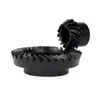
Imagine you’re prepping a wide-area rotary cutter for the first cut of the season. As you engage the PTO, a cyclical howl or rhythmic knocking emerges from the gearcase—something that wasn’t there last autumn. Bevel gears in agricultural gearboxes operate under extreme pressure and sliding contact. When the case-hardened surface begins to degrade, the rolling and sliding action becomes irregular, producing a distinct whine or rattle, especially under load. This is a telltale sign of pitting, spalling, or improper backlash. Ignoring it means the noise will only amplify until tooth fracture occurs, often taking the entire gearbox with it. Raydafon Technology Group Co.,Limited supplies precision-ground spiral bevel gear sets that are lapped in pairs to ensure optimal contact pattern right out of the box—dramatically reducing the risk of noise-related failure in demanding rotary tiller and mower applications.
During a long day of top-dressing, you might notice the gearbox housing becomes unusually hot to the touch, accompanied by a buzzing sensation transmitted through the frame. While gearboxes naturally generate heat, a sharp rise in temperature combined with new vibration signals accelerated wear. Damaged tooth flanks lose their smooth meshing geometry, creating friction spikes that convert mechanical energy into heat. This overheating thins the lubricant film, worsening the wear cycle. When procurement managers see a pattern of gearbox replacements across their fleet, it’s often traced back to a worn bevel gear that was running hotter than spec. In our testing, Raydafon gearboxes with optimized tooth geometry maintain nominal temperatures up to 20% lower than generic aftermarket units, preserving oil viscosity and extending service intervals.
| Symptom | Possible Cause | Recommended Action |
|---|---|---|
| Cyclical howl under load | Pitting or spalling on gear teeth | Inspect gear set, measure backlash; replace with matched pair |
| Knocking at low speed | Broken or chipped tooth | Immediate teardown; install new bevel gear set to avoid housing damage |
| Overheating housing (>90°C) | Excessive friction from worn flanks | Check oil level/quality, replace gear set, upgrade to synthetic gear oil |
| Strong vibration through frame | Uneven tooth wear or misalignment | Verify bearing condition, align shafts, replace worn gear |
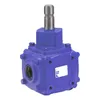
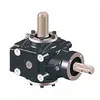
You’re walking the equipment yard after a rain shower and spot a milky emulsion weeping from a gearbox breather. Or perhaps you drain the oil and find a metallic glitter suspended in what should be transparent fluid. Worn bevel gears shed fine metal particles that contaminate the lubricant, accelerating abrasive wear on bearings and seals. As the seals degrade, moisture and dirt enter the gearcase, forming an acidic sludge that pits gear surfaces further. This contamination cascade often leads to complete gearbox seizure. At Raydafon, every Agricultural Gearbox we produce undergoes a double-seal test and is filled with high-pressure-resistant oil seals. What are the signs of a worn-out bevel gear in an agricultural gearbox? Frequently, the first visual clue is dirty oil that has turned gray or contains visible metal flakes—a clear signal to stop and inspect before the damage spreads.
If preventative maintenance gives you a chance to open the inspection cover, the gear teeth themselves will tell you the truth. Hold a bright light to the spiral bevel gear: healthy teeth should have a smooth, slightly burnished contact pattern across the center of the flank. Signs of wear include micropitting (a frosted appearance), spalling (larger craters), and plastic deformation where the tooth edge begins to roll over. Scuffing marks indicate lubrication failure. Each of these reduces load-carrying capacity and foreshadows rapid tooth breakage. Raydafon Technology Group Co.,Limited applies advanced case-carburizing and finish grinding processes to deliver bevel gears with a surface hardness of HRC 58-62, resisting the very pitting that routine inspection catches too late in many commodity gearboxes.
Picture a precision seed drill that starts leaving uneven rows or a mower that bogs down in light grass. You might first suspect the tractor engine or hydraulic system, but a worn bevel gear inside the implement gearbox can mimic those symptoms. As backlash increases from wear, the timing between PTO input and output shaft becomes erratic, robbing you of the uniform torque needed for accurate distribution or cutting. This performance drift is often subtle at first but becomes obvious when neighboring machines with healthy gearboxes work circles around the compromised one. Our Raydafon replacement gearboxes are designed to meet or exceed OEM center distance tolerances, ensuring that when you hit the field, the implement response is immediate and predictable, hour after hour.
Q: What are the signs of a worn-out bevel gear in an agricultural gearbox if the machine is not disassembled?
A: Even without opening the case, you can detect a worn bevel gear through increased operating noise (a distinct whine or knock that changes with load), higher housing temperatures, noticeable vibration felt through the frame, and declining implement performance. Checking the oil for metal particles provides additional evidence. Raydafon recommends vibration analysis and thermography for large fleets, enabling early detection long before a catastrophic failure.
Q: Can a worn bevel gear be repaired, or must it be replaced?
A: Because bevel gears are profile-ground as matched sets, repairing just one tooth or attempting to weld and remachine is rarely successful in high-load agricultural applications. The heat from welding alters the case hardness, and the gear will fail again rapidly. The best economic decision is to replace the entire bevel gear set with a factory-matched pair. Raydafon Technology Group Co.,Limited offers direct-replacement bevel gear kits for many popular gearbox models, including complete gearbox assemblies that drop into existing PTO-driven equipment with minimal downtime.
By now, you’ve seen how a single worn gear can snowball into field stoppages, missed planting windows, and unplanned procurement headaches. The common recommendation to simply ‘replace the gearbox’ means little if the replacement unit carries the same metallurgical limitations. That’s where a supply partner who understands agricultural duty cycles becomes a critical asset. Raydafon Technology Group Co.,Limited has spent years refining gear tooth profiles, seal designs, and housing rigidity specifically for the shock loads, dust, and seasonal intensity that define modern farming. When you need what are the signs of a worn-out bevel gear in an agricultural gearbox translated into a confident purchase decision, our engineers can help you read the symptoms and select the right gearbox solution the first time.
We invite you to share your most challenging gearbox failure experience in the comments—did you catch it early, or did it catch you at the worst possible moment? Your insight helps the entire farming community plan smarter maintenance cycles. If you’re currently sourcing gearboxes or bevel gear sets for your equipment lineup, reach out to us. Raydafon Technology Group Co.,Limited is a leading manufacturer of agricultural gearboxes and power transmission components, serving equipment builders and fleet operators worldwide. With ISO-certified production and a deep focus on spiral bevel gear technology, we deliver customized and standard solutions that reduce downtime and protect your machinery investment. Visit our website at https://www.raydafon-reducers.com and contact our technical team at [email protected] for a consultation or a quote tailored to your specific application.
Litvin, F.L., Fuentes, A., 2004. Geometry and Design of Involute Spur and Helical Gears. Cambridge University Press, Cambridge.
Radzevich, S.P., 2012. Theory of Gearing: Kinematics, Geometry, and Synthesis. CRC Press, Boca Raton.
Townsend, D.P., 1992. Dudley’s Gear Handbook: The Design, Manufacture, and Application of Gears. McGraw-Hill, New York.
Krantz, T.L., Kahraman, A., 2004. An Experimental Investigation of the Influence of the Lubricant Viscosity and Additives on Gear Wear. Tribology Transactions, 47(4), 559-565.
Höhn, B.R., Michaelis, K., 2004. Influence of Oil Temperature on Gear Failures. Tribology International, 37(2), 103-109.
Seetharaman, S., Kahraman, A., 2009. A Physics-Based Model to Predict Micropitting Initiation in Lubricated Point Contacts. Journal of Tribology, 131(4), 041502.
Hoffman, N.P., Gehringer, M.A., 2017. Agricultural Gearbox Load Spectra and Fatigue Life Assessment. Transactions of the ASABE, 60(2), 367-375.
ISO 6336-2:2019. Calculation of Load Capacity of Spur and Helical Gears – Part 2: Calculation of Surface Durability (Pitting). International Organization for Standardization, Geneva.
AGMA 2003-B97, 1997. Rating the Pitting Resistance and Bending Strength of Generated Straight Bevel, Zerol Bevel, and Spiral Bevel Gear Teeth. American Gear Manufacturers Association, Alexandria.
Xu, H., Kahraman, A., 2007. Prediction of Friction-Related Power Losses of Hypoid Gear Pairs. Journal of Mechanical Design, 129(3), 332-339.